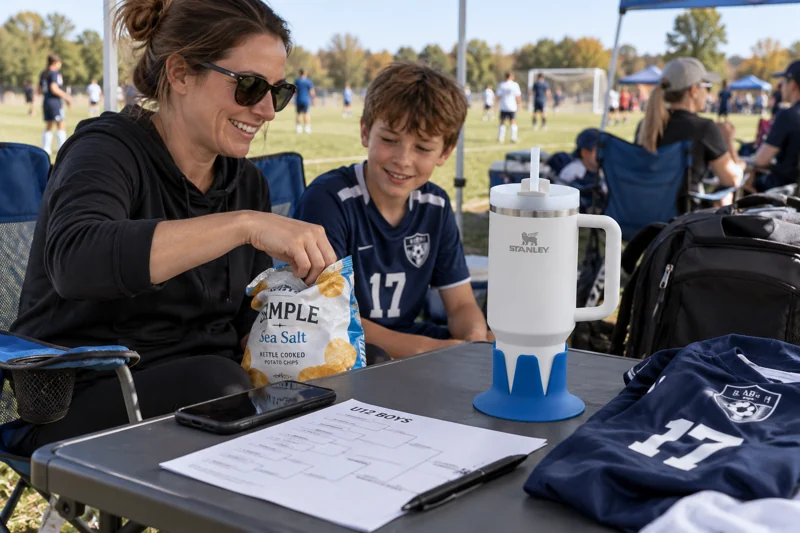
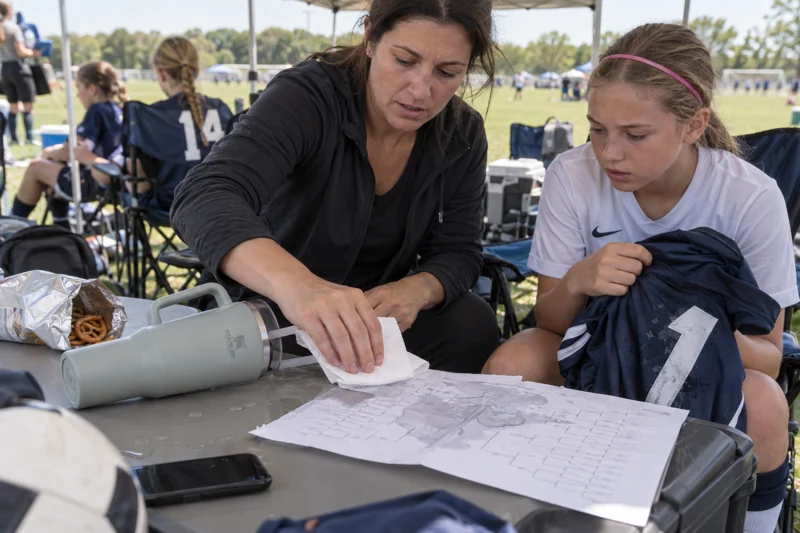
—A base for the plank, the cooler lid and the parked wagon
Your chair’s cup holder is a sewn mesh pocket for one reason, and a 1999 patent says it out loud: the holder is “a bag made of collapsible material” so that “it is easily foldable along with the foldable chair.” The fold is the invention. The pocket is what the fold costs.
Chair, canopy, wagon, cooler — every object you unloaded this morning passed the same test. It has to collapse. A rigid ring wide enough for a 40 oz tumbler cannot. So this is a 5.2″ base that stands on the plank, the cooler lid or the parked wagon bed instead, and holds by width.
4.9 average · 121 reviews
Add it to the sideline kitfrom $14.95 · free shipping on every order
Ships from Orange, California. 90 days to change your mind, used is fine.
—Read this before anything else
A tournament complex is not a venue. It is acreage with backstops on it. Grand Park in Westfield, Indiana publishes 400+ acres, 26 diamonds and 31 fields on its own campus map. Sports at the Beach in Delaware runs 16 natural grass fields. There is no seating bowl, no concourse, and no permanent spectator furniture to hang anything off — the ground gets cleared and reset between weekends by a mower.
Ripken Baseball states the provisioning model in one sentence in its own FAQ: “Seating is available at every field, but we encourage you to bring your own tents and chairs for additional comfort.” Whatever you sit on, shade under or drink from, you carried in through the gate. And every single thing you carried had to fold to get there.
Sewn mesh
it has to fold
A fabric sleeve with no diameter of its own and air under the floor. It takes the shape of whatever you put in it.
$19.95
a 1″ square pole
Works. On that one pole profile, at that one leg, thirty feet from where you are actually sitting.
Two of them
mesh, again
A vehicle rated to 300 lb whose entire beverage provision is two fabric pouches sewn to a soft-sided bin.
$14.95
nothing to clamp to
A 5.2″ moulded base, about 3.6 ounces, that the drink stands in. Plank, cooler lid, parked wagon bed, grass.
Two things fall out of that. Every drink provision in your kit was drawn around a 12 oz can — and you will read one seller say so in its own words further down. And you do not set up once: USSSA Florida Baseball’s bracket format page says its divisions play “three (3) MIXED POOL PLAY games” and that “ALL teams go to a minimum of two (2) bracket games.” Five games, two days, a different field most times. Anything that clamps has to be unclamped and reclamped at every one of them.
Sources: grandpark.org · sportsatthebeach.com · ripkenbaseball.com · flbaseball.usssa.com · hotshotpowerequipment.com · macsports.com. All fetched 4 September 2026.
—The tell that this is real
Read that again, because it settles the argument. The patent is not conceding a compromise. That is the invention. The holder is fabric because the chair folds, and the folding is the whole reason the chair exists.
And the numbers say there was never another option. You cannot hide a rigid ring wide enough for a modern tumbler inside a 5.9-inch package. So the ring becomes a sewn sleeve, which is the only cup-holder geometry that folds flat.
Stadium seats get real cup holders because a stadium always has something vertical and permanent to bolt one to. Your sideline has nothing permanent at all, by design, and it never will.
Crown’s specification for the 12 oz / 355 ml Standard can gives a body diameter of 66 mm and a height of 122.22 mm — about 2.6 inches across and 4.8 tall. Short, light, squat. A fabric pocket handles that all day.
Stanley’s own page for the Quencher H2.0 40 oz lists a height of 11.02 inches, a base diameter of 3.1 inches and a weight of 1.18 lb empty, at $27.00 on sale from $45.00. Forty fluid ounces of water weighs about two and a half pounds on its own, so filled with ice that cup is pushing four.
Now run the ratio. US Patent 7,516,931, “Beverage container holder,” granted 14 April 2009 to Phillip Sarullo, says containers are “predisposed to tipping due to the dimension of the height of the container in comparison to the dimension of its base,” and that “the height of a soft drink can is often more than twice the diameter of its base, and the height of a beer bottle is often more than three times the diameter its base.”
An 11.02-inch tumbler on a 3.1-inch base is about 3.6 to 1. By that patent’s own yardstick the drink in your hand is tippier than a beer bottle, and it weighs roughly four times what the mesh pocket was drawn for. The mesh did not get worse. The drink got taller, heavier and narrower at the bottom, and the pocket stayed where it was in 1999.
It is not only a camping-gear failure, either. J.D. Power’s 2025 Initial Quality Study surveyed 92,694 new-vehicle owners and found cup holders a rising complaint because, as CarPro reported it, “owners are now bringing more reusable containers into their vehicles, manufacturers are struggling to keep up.” Car companies have injection tooling and years of lead time on every model, and the tumbler still got ahead of them. A $56 chair with a sewn pocket never stood a chance.
Sources: patents.google.com (US5893605A, US7516931B2) · gcioutdoor.com · crowncork.com · stanley1913.com · carpro.com, reporting the J.D. Power 2025 U.S. Initial Quality Study. All fetched 4 September 2026.
—Does it actually work
Somebody sits down beside it and the drink comes back level. The base is 5.2 inches across, so the whole thing has to lean a long way before it goes over — which is the difference between a footprint and a pocket.
Filmed on a couch cushion, not at a complex. It is the honest footage we have, and a cushion is a soft, uneven, unhelpful surface rather than a flattering one. What it does not show is a wagon being pulled, and we are not going to shoot that, because nothing loose survives a loaded wagon over gravel. See the limits below.
—Why a footprint beats a pocket
A real cup holder is a diameter: a fixed circle with a rigid floor at a known depth. A mesh sleeve has none of that. It has no diameter of its own, its floor is fabric with air underneath, and it holds a cup upright only to the extent the cup already was.
This is the other answer. The base is 5.2 inches across and it does not change — it is one fixed footprint under the drink, so the centre of mass has to travel much further sideways before it clears the edge of its own support. Tipping takes a far bigger tilt than it does on the cup’s own bottom. That is the entire mechanism, and it is why it resists tipping instead of preventing it.
The tack of the TPU is the second half. It plants where you set it on an aluminium plank or a moulded cooler lid, and then lifts straight off when the ice run comes.
—The object
It folds nothing, because there is nothing in it to fold. It lies flat in the chair bag next to the folded chairs.
—What seats and what does not
The honest version on the drink you actually carry: Stanley publishes the Quencher H2.0 40 oz base at 3.1 inches, and the fins open to 3.15. It is inside the range — and it is the tightest thing in the line-up, on a cup that has shipped in more than one generation. So check the one you own rather than trusting a chart. A steel player bottle and a 12 oz can are nowhere near the limit.
Handled mugs are an honest no — a handle running down to the base lands exactly where a fin grips. Stemmed glasses do not seat either. Both are a straight no, and you should know that before you pay rather than after.
Every width below comes from a published specification, not from us. Where a spec is uncertain, the answer says so.
A width across the bottom of the cup, in inches.
A standard sticky note is three inches square, a hair under what the fins open to. Stand the cup on one on the kitchen counter tonight. If the bottom sits inside the paper, it seats.
Anything that overhangs, or anything borderline — hello@steadilabs.com reaches a person, and the answer will be honest either way, including a no.
—Where it goes
The plank. Set it on the bleacher board beside your foot, not out on the walking line where the row goes past. Aluminium is smooth, slightly sloped and it rings when everyone stands up for a bang-bang play at first — which is the moment a cup on bare metal goes.
The cooler lid. The only table on site, and also the only ice, so it gets opened all weekend. The base lifts off in one motion with the drink still in it and goes back down after. It is not fighting you for the lid.
The wagon bed, parked. Between fields the wagon is a table. Loaded and moving it is not, and nothing on this page claims otherwise.
The grass, and the folding side table. Beside the chair leg is exactly where cleats and chair legs travel, and grass is never level. A wider foot buys you tilt before the drink goes over. It does not buy you a force field.
Twelve colours, one per unit — which is the fastest way to stop four families along the same fence line arguing about whose tumbler is whose.
—What the sideline kit already costs
Prices and requirements were looked up on 4 September 2026, not estimated. Every figure in the last column is the seller’s own published requirement or its own published words.
| The product | Price | What it asks for |
|---|---|---|
| The chair’s mesh cup holder | Comes with the chair | That your drink be a 12 oz can. GCI Outdoor’s Kickback Rocker is $56.00 from $70.00 and folds to 5.9″ × 7.9″ — there is no room in that package for a rigid ring. |
| Clamp-on canopy-leg holder | $19.95 | A 1-inch square pole, stated on the page. So is the capacity: “The cup holder is sized to fit a 12oz can with a coozy.” |
| Fence-hung cup holder | from $15.99 | Chain-link, and a drink that can live on the fence rather than beside you. “Designed to easily attach to fences.” It says it “Securely holds any size beverage” but publishes no diameter, so measure first. |
| The wagon’s two mesh pockets | Comes with the wagon | Mac Sports lists its Push & Pull Wagon at $169.99, rated to 300 lb, with “2 mesh cup holders and a mesh pouch for light storage use.” |
| A canopy counter | from $350.00 | E-Z UP’s accessories line lists sidewalls, roller bags, lighting, chairs, tables, anchors, misting fans and heaters — and no cup holder anywhere in it. The nearest drink surface is a counter top. |
| Another one from the snack shack | Whatever it is today | Nothing, except that you walk away from the at-bat to get it. Be honest: this is the incumbent, and it is the only one on the list you buy again every single time. |
| The Travel Ball Cup Holder | $14.95 · four for $39.95, $9.99 each | A flat surface under it. A plank, a cooler lid, a parked wagon bed or a patch of grass will do. |
Three honest concessions, because this crowd has already bought one sideline thing that did not survive a season.
The fence hook works. If your drink can live on the fence for the length of a game, buy it — that is a real product solving a real version of this, and pretending otherwise would be dishonest. The canopy clamp works too, on the one pole profile it was cut for; match the profile and the canopy is solved. And a folding side table is a genuine fix — it is also one more thing to carry, set up and break down five times in a weekend, and a table is a surface, not a holder.
What none of them do is come with you. You are in a chair, in a line of chairs, well down the third-base line and nowhere near the canopy leg — and none of it moves to Field 3 with you when the bracket does.
Sources: gcioutdoor.com · hotshotpowerequipment.com · the-fence-buddy.com · macsports.com · ezup.com. Prices and specifications fetched 4 September 2026 and current as of that date. Steadi Labs is not affiliated with any of them, and those names identify their own published products only.
—Get one
For most families that is two — one for your chair, one for whoever is beside you. Four covers the wagon bed and the grandparent who comes to every game. Free shipping on all of them.
Checkout is handled by Steadi Labs — the company that makes The Travel Ball Cup Holder. Secure checkout at steadilabs.com. Free shipping on every order, and 90 days to change your mind, used is fine.
—From people who bought one
Verbatim, unedited, not filtered by rating. This is a slice of one product-wide corpus — reviews of the Steadi, not of this page. Not one of them mentions travel ball, pool play or a complex. The four below are here because they name the surfaces this page is claiming: a sloped metal bench, a cooler lid, a pop-up canopy over lawn chairs, and a Stanley.

★★★★★
Steadi- Just what I was looking for! I purchased these to use at our annual NASCAR race this month. They delivered beyond my expectations. Our seats are metal benches with a slight slope towards the back, making it impossible to set down any type of drink. We were able to use these for a 20oz bottle with a koozie on it as well as a slim can with an insulated Brumate on it! They worked perfect, holding our drinks on the bench & on our cooler. I highly recommend for sporting fans, boaters, outdoor adventures. Thanks for making these!
Holly J · June 2026Photo from the buyerPhoto from the buyerPhoto from the buyerPhoto from the buyerPhoto from the buyerPhoto from the buyerPhoto from the buyer

★★★★★
Excellent Fits my small Stanley water bottle perfectly. Highly recommended
Connie Waters · June 2026Photo from the buyerPhoto from the buyerPhoto from the buyerPhoto from the buyerPhoto from the buyerPhoto from the buyerPhoto from the buyer
★★★★★
My Steadi order arrived just as we were packing for our annual three generation family vacation. So into the car they went. Our time away is at a rental property and preventing spills in someone else’s house seems like a good goal. Additionally, most of our time is spent outside, at the house and nearby parks. The Steadi has been popular for sitting out under a pop up canopy on lawn chairs and at a picnic at a nearby state park. We brought the four we ordered and have already placed an order for more since family members have claimed the first ones!
Haila Buskirk · May 2026
★★★★★
They are great! They work very well in keeping the soda cans from falling over and spilling on the bed & couch when the three Beagles and one Border Collie jump on or off. They also stay steady on the little wobbly patio table outside.
Susan Ilkenhans · May 2026
Sent in with their reviews. Tap any one to read it. Different rooms, different drinks, different colours — none of them staged by us.
Read Connie’s carefully before you order: she says the small Stanley, not the 40 oz. The 40 is the tight one, and the sticky-note test above is the reason we keep telling you to do it at the counter.
—Read this before you buy, including the parts that cost us the sale
Sources: usssaspacecoast.com · cooperstowndreamspark.com · ripkenbaseball.com, each complex’s own published policy page, fetched 4 September 2026. Policies change, and the complex is the authority on the day.
—Ninety days
Ninety days from delivery, used is fine. That covers most of a spring season’s worth of weekends — the dew, the gravel, the aluminium, the ice runs and whichever of your kid’s teammates kicks it first. If it turns out the mesh pocket on your chair was fine all along, send it back.
—Who makes it
Scott Rodriguez made the first one after a full drink went over on a soft cushion, with three children under three in the house. It was built for a surface that will not hold a cup.
It was not designed for a tournament complex, and no travel-ball family asked for this page. It exists because a fixed 5.2-inch footprint does the same job on a bleacher plank that it does on a couch cushion, and because everything it will not do out there is written above rather than left out.
We make one thing and we make all of it here — the moulds, the material, the colour runs, everything within about three and a half miles of the shop.
— Scott, Steadi Labs
—Asked and answered
No. Nothing loose does, and anyone who tells you otherwise is selling you a video. Carry the drink in your hand between fields and set it back in the base once the wagon is parked. That is the honest answer and it is the same one we would give you at the fence.
Stanley publishes the Quencher H2.0 40 oz base at 3.1 inches and the fins open to 3.15, so yes — and it is the tightest thing in the range. That cup has shipped in more than one generation, so stand yours on a three-inch sticky note tonight. If the bottom sits inside the paper, it seats.
Both are well inside the range and neither is close to the limit. A 24 oz sports bottle is about 2.87 inches at the base, and a 12 oz can is about 2.6.
If it holds what you drink, use it and keep your money. It is a sewn mesh sleeve with a fabric floor, drawn around a 12 oz can, and it does fine with a bottled water. It is a hammock under a full 40 oz tumbler, which is a different object entirely.
There is nothing on it to break — one moulded piece, no hinge, no clamp, no spike, no spring. It rinses in the driveway or goes in the dishwasher, top rack. Ninety days is long enough to find out for yourself, and used is fine coming back.
They can, and one eventually will. Beside your foot rather than out in the walking line is most of the answer, but a determined cleat still wins and we are not going to claim otherwise.
No. It attaches to nothing at all — it stands on the surface and lifts off. If you want something on the fence, the fence-hung holders in the table above are the real product for that job.
—Still deciding
The Aspen Institute’s Project Play survey of 1,848 youth-sports parents, run with Utah State and Louisiana Tech in late 2024, found the average U.S. sports family spent $1,016 on a child’s primary sport that year, up 46% in five years, with baseball the priciest of the three most popular sports. Nobody reading this is hesitating over fifteen dollars.
You are hesitating because the garage is already full of tournament gear that did not earn its spot. Fair. So here is the test: it has to work on a plank, a cooler lid, a parked wagon bed and a patch of grass, with nothing to clamp to on any of them, and it has to still be in one piece in June. If it is not, ninety days and it goes back.
Source: projectplay.org, Project Play parent survey with Utah State University and Louisiana Tech University, fielded November–December 2024. Fetched 4 September 2026.
A school can at least be asked about rail-mounted holders on a permanent guardrail. A tournament complex has no permanent spectator furniture to modify — that is the operating model. The fields get cleared and reset between weekends, and the seating is whatever the families carried through the gate that morning. So the fix has to fit in the chair bag, work on five surfaces in one day, and not care that nothing out there is bolted to anything.
You just don’t have to keep putting the coffee in the grass.
Add it to the sideline kitfrom $14.95 — free shipping on every order
90-day guarantee, used is fine · Made in Orange, California